
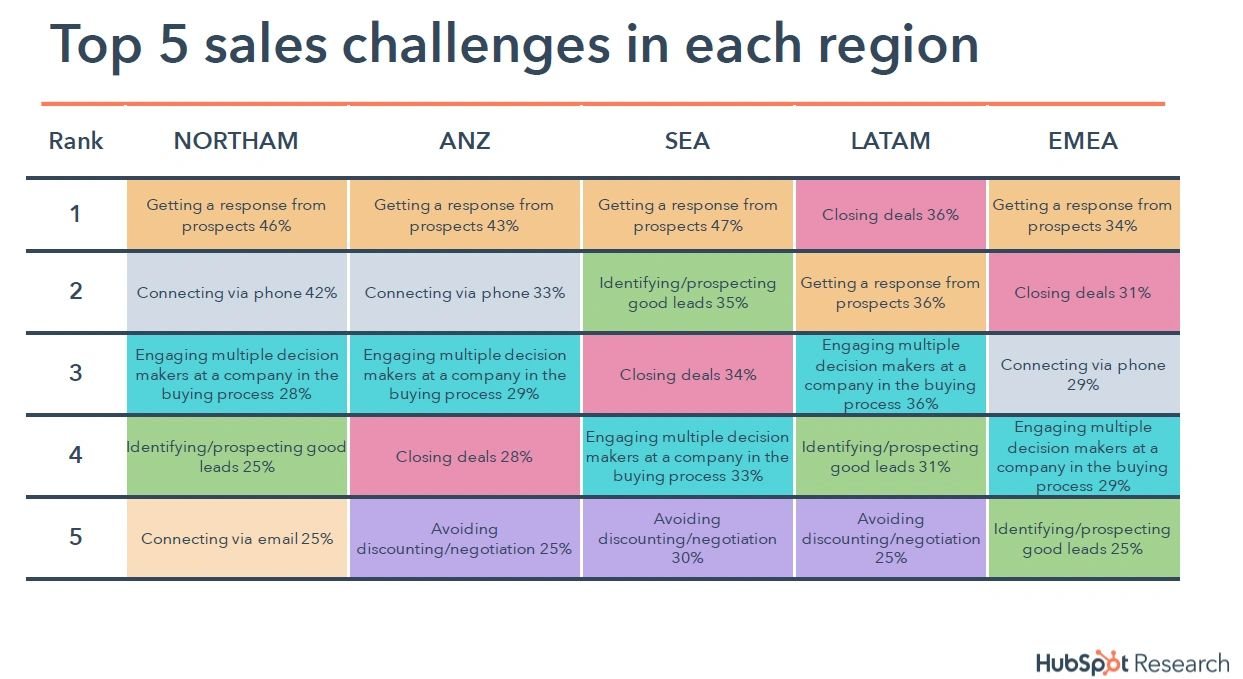
A recent study from Hubspot found the top 5 challenges for sellers in reach region. Not surprisingly, there is a direct correlation to opt-in laws for electronic communication.
Southeast Asia: 47% Getting Responses from Prospects. Since India is the largest player in this space (sorry China), and there are no Opt-In laws to speak of, buyers in this part of the world are inundated with electronic communication.
Solution: Try the Account-Based targeted messaging approach. Spending more time on less prospects often seems counter intuitive, but the results should be tailored messaging that will be better received by your prospects.
North America: 42% Connecting via Phone. Canada and the United States are on the opposite ends of the spectrum for opt-in laws. In the US, CAN-SPAM laws allow for unsolicited communication until the recipient requests to be opt-out. In Canada, CASL requires recipients to be opted-in before solicatiation starts.
Solution: Try calling the decision maker directly with a compelling message. Most sellers get bogged down in phone trees and gatekeepers, causing phone fatigue. Dialing the decision maker directly will cut prospecting time in half.
Latin America: 36% Closing Deals. Decisions in Latin America are made locally and globally. Local sellers make the mistake of assuming corporate decisions are all made locally and sellers from outside the country assume they can influence decisions without local help.
Solution: Try building out a buying committee that shows all of the buyers. The process involves starting with the go-live date in your process. Take inventory of the people involved with set up, training, and logistics. Then, deduce who is involved in the contract signing, approval, and decision making process. All of these people influence the decision – both inside and outside of the country – and should be part of your closing strategy.
EMEA 29%: Engaging Multiple Decision Makers in the Buying Process. The GDPR, or General Data Protection Regulation covers most Europeans and requires data providers to have consent from their contacts if they are to be made available. Companies like ZoomInfo don’t even provide GDPR compliant data so for them, identifying decision makers is a tough task.
Solution: Try GDPR compliant data where the users have made themselves available on the public web. Social media sites like LinkedIn, Twitter, and Xing are great medians as well as press releases and corporate websites. Companies like Google and RampedUp search these public profiles and provide rich contact intelligence sellers need to engage their buyers in the buying process.
Australia / New Zealand: 25% Avoiding Discounting. Value is relative based on scarcity and need. It is much easier to hold your price when you know the alternatives the buyers have and the source of urgency for the purchase.
Solution: Try tying your proposal to a triggering event. Companies do a great job of sharing good news in the form of press releases and social media updates. Identify what is happening at your prospect via these triggering events and tie your solution to it.