
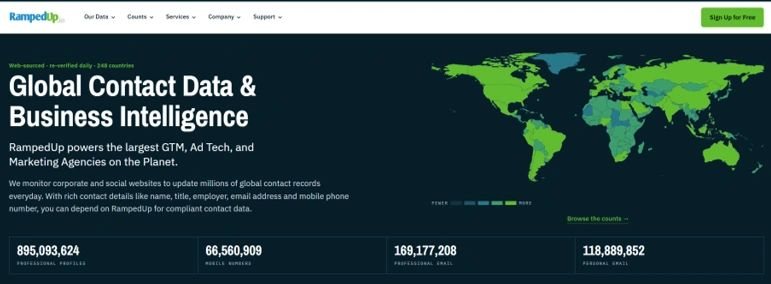
We rebuilt the site around a simple idea: a data company should be able to show its work. The counts are published. So is the privacy program.
Buying B2B data usually starts the same way. You ask how many records a vendor has in your segment, and you get a meeting invitation.
We have never enjoyed being on either side of that conversation. So the new site does the opposite: the counts are on the website — broken out by country, state, industry, NAICS, SIC, company size, revenue band, job function and title level, with no form in front of them.
If a number is worth selling on, it should be worth publishing.
As of the August 2026 build there are 895,093,619 professional profiles across 248 countries. You can see how that distributes without talking to anybody.
Just the Counts
Publishing counts creates an obligation to be honest about their limits, and here is ours.
Our count cube holds one dimension at a time. Ask how many professional profiles we have in Germany, or how many carry a mobile number, and the answer is read straight out of it and is exact. Ask for IT directors in Germany with a mobile number, and the cube has no such cell.
Most vendors would multiply two percentages together and quote you the result as a count. The Count Explorer does the arithmetic too — but it labels the answer an estimate, shows the ceiling it cannot exceed, and tells you it is an independence assumption rather than a measurement.
If you need the real cross-filtered number, ask and we will run it against the live file. That is a sales conversation we are happy to have, because it starts with an accurate premise.
The Privacy Center
The other half of showing your work is showing how the data is governed. Procurement, legal and privacy teams are on the buying committee in this category, and they should not have to schedule a call to get through a checklist.
So there is now a Privacy Center, and it holds the answers rather than pointing at an inbox:
- A privacy-law lookup. Pick a country — or the United States and then a state — and it names the principal comprehensive privacy law that applies there, the framework we work under for it, and the statutory language on publicly available information where we hold it. 245 jurisdictions: 51 US states and DC, plus 194 countries.
- A page each for GDPR, CCPA and the Data Privacy Framework. Our rights process step by step, our authentication requirements, and our DPF certification, ID 7816.
- The Data Processing Addendum, downloadable. Twenty-one pages including Schedules 1 and 2 and the Standard Contractual Clauses. Not on request. On the page.
- Every sub-processor, named. All nine, with the thirty-day notice and objection process spelled out.
- Our data broker registrations, with the numbers — California 538248, Oregon 00344, Texas 20250186, Vermont 0409326 — so you can verify us independently rather than take our word for it.
- Twelve security documents, from the information security policy to the incident response plan and the retention policy.
You should not have to ask us for the things you are going to ask us for.
Data Dictionaries
The Data Dictionary now lists every field we carry — contact, company and technographic — with its type, its meaning, how many records have it, and a CSV of each. The API documentation links every endpoint to the fields it returns, and the Swagger portal lets you run the calls before you write any code. How-to videos are on the site rather than behind a login.
And there are comparison pages against eight providers people evaluate us next to. They say plainly what each competitor does well. We would rather write those ourselves, accurately, than leave it to someone else.
rampedup.io still works and will for a while. Everything new lands on rampedup.ai first.