
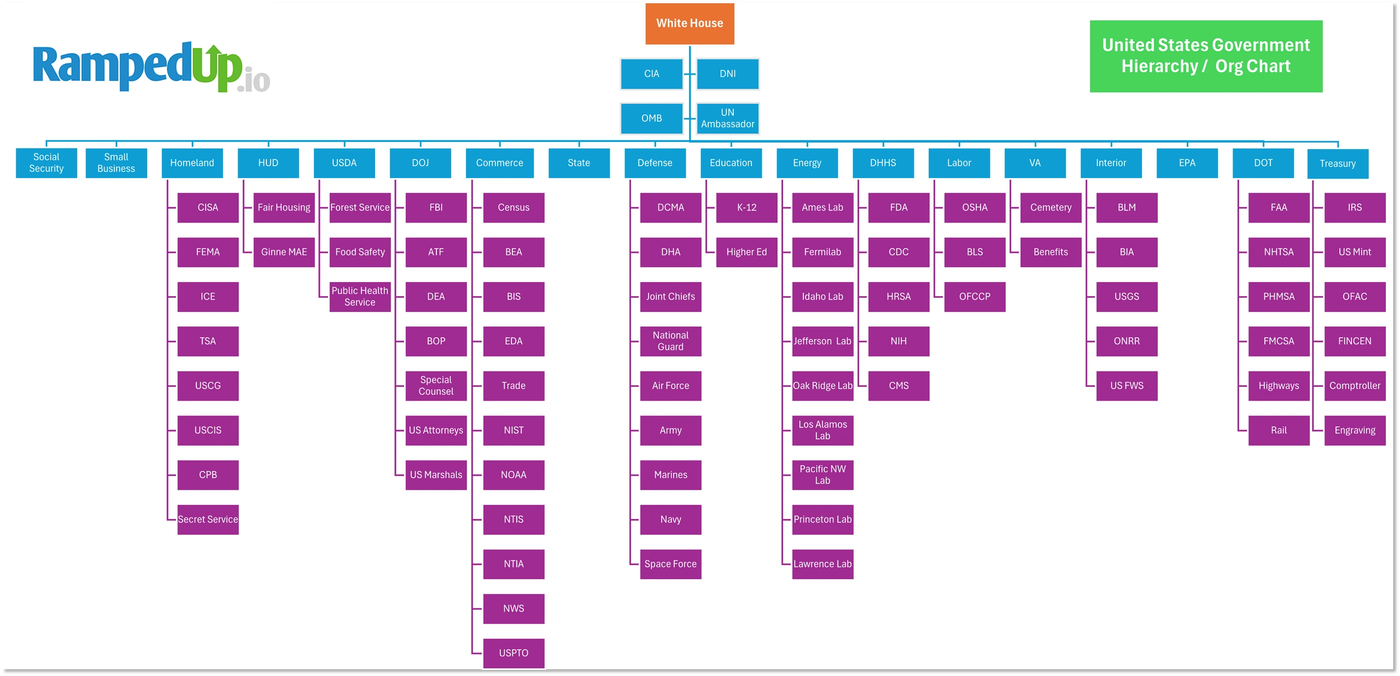
The US Government Hierarchy: Download CSV of 650 Agencies, Bureaus, Courts, and Commissions. Complete with Website / Leadership Links / and Hierarchy Affiliation across the 3 Branches of Federal Government.
With 22 Cabinet level agencies, a 3-teired US Court System, and Independent Commissions, navigating this intricate web can be challenging. That's why we created a comprehensive list of 650 entities in the CSV provided here.
After you check out the list, let us know if we can us our newest AI Agent technology to create a custom dataset from these leadership links.
Cabinet Level Agencies
The President of the United States is supported by a diverse group of 22 Cabinet Level Agencies, each responsible for overseeing critical aspects of the nation's governance. These agencies include well-known departments such as State, Defense, Treasury, and Justice, as well as specialized entities like the Environmental Protection Agency and the Small Business Administration.
Each agency is led by a senior official who reports directly to the President, providing expertise and management in their respective domains. From safeguarding national security through the Department of Homeland Security to promoting economic growth via the Department of Commerce, these agencies collectively form the executive branch's backbone. They implement the President's policies, manage vast federal resources, and address complex challenges facing the nation. The Cabinet Level Agencies span a wide range of focus areas, including agriculture, education, energy, health and human services, housing and urban development, labor, transportation, and veterans affairs, ensuring comprehensive coverage of national priorities. Every Office, Bureau, and Directorate comprising the Agency is also detailed in the attached list.
The US Court System
The US Federal Court System is structured in three main tiers. At the base are 94 District Courts, which serve as the primary trial courts for federal cases and are detailed our list. These courts handle both civil and criminal matters, with at least one district court in each state. Above the District Courts are 13 Courts of Appeals, also known as Circuit Courts, which review decisions made by the lower courts. These appellate courts are organized into 12 regional circuits plus the Court of Appeals for the Federal Circuit, which has nationwide jurisdiction for specific types of cases. The Courts of Appeals do not conduct trials or hear new evidence, but instead focus on determining whether the law was correctly applied in the district court proceedings. At the apex of the federal judiciary is the Supreme Court of the United States, consisting of nine justices, which has discretionary power to review cases from both lower federal courts and state courts involving federal law or constitutional issues.
Reference:
- Department of Agriculture (USDA)
- Department of Commerce
- Department of Defense
- Department of Education
- Department of Energy (DOE)
- Department of Health and Human Services (HHS)
- Department of Homeland Security (DHS)
- Department of Housing and Urban Development (HUD)
- Department of the Interior (DOI)
- Department of Justice (DOJ)
- Department of Labor
- Department of State
- Department of Transportation (DOT)
- Department of the Treasury
- Department of Veteran Affairs